After Your Dyslexia Test: A Parent's Guide to Formal Evaluation
Receiving a high-risk result from an online screening or noticing that your child struggles with reading can feel overwhelming. You know something needs to be addressed, but the path forward can seem unclear and complicated. You might be asking yourself, "What comes next after an initial screening?"
Navigating the world of learning differences is challenging. But you are not alone. This guide demystifies the formal dyslexia evaluation process. We will walk you through each step, from understanding what it is to preparing for the assessment and interpreting the results.
Taking the first step is often the hardest, but it's also the most important. An initial check, like a free online dyslexia test, can provide valuable insights and direction. This guide will help you confidently take the next step on the journey to unlocking your child's full reading potential.

Understanding the Formal Dyslexia Assessment Process
A formal dyslexia assessment is much more than a simple test. It is a comprehensive process designed to build a complete picture of your child’s learning profile. Understanding this process helps reduce anxiety and empowers you to advocate effectively for your child.
Screening vs. Formal Diagnosis: Key Differences
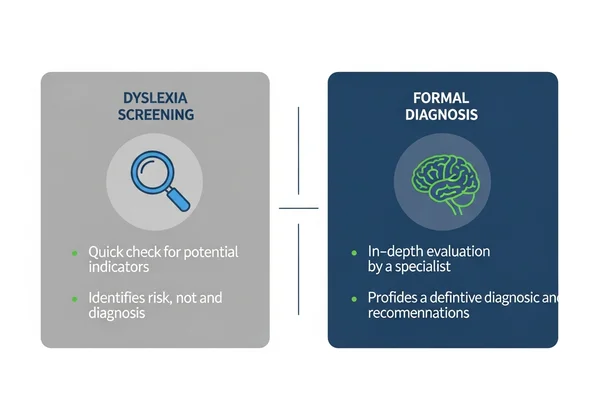
It's crucial to understand the difference between a screening and a formal diagnosis. They serve different but equally important purposes.
A dyslexia screening, like our free online tool, is a brief, informal tool used to identify potential risk factors. It’s an excellent first step that can highlight areas of concern quickly and without cost. Think of it as a check-up that tells you if a deeper look is warranted.
A formal diagnosis is different. It's a detailed, clinical evaluation conducted by a qualified professional. It involves a wide range of standardized tests to measure specific skills. The goal is to understand your child's unique cognitive profile—both strengths and weaknesses. A formal diagnosis is also required to access special education services and accommodations in most schools.
Who Conducts a Dyslexia Evaluation? (Providers Explained)
A formal dyslexia evaluation must be conducted by a professional with specific training in learning disabilities. Here are the most common providers:
- Educational Psychologists: These professionals specialize in understanding how children learn. They often work within school systems or in private practice and are experts in administering and interpreting educational assessments.
- Clinical Psychologists: While their focus can be broader, many clinical psychologists have expertise in developmental and learning disorders. They can evaluate for dyslexia as well as co-occurring conditions like ADHD or anxiety.
- Neuropsychologists: These psychologists specialize in the relationship between the brain and behavior. They conduct highly detailed assessments to understand the cognitive processes underlying learning challenges.
- Certified Reading Specialists: Some reading specialists with advanced degrees and certifications are qualified to conduct parts of an evaluation, often as part of a larger team.
Choosing the right provider depends on your specific needs, location, and resources. Your child's school may be able to provide a referral or conduct an evaluation themselves.
What to Expect During a Dyslexia Evaluation
Knowing what the evaluation entails can help you and your child feel more prepared and relaxed. The process is supportive. It’s not like a typical school test where one "passes" or "fails." The only goal is to gather information.
Key Areas Assessed in a Comprehensive Evaluation
A thorough evaluation will look at many different skills to create a complete profile. It isn't just about reading. The professional will likely assess:
-
Phonological Processing: This is the ability to recognize and work with the sounds in spoken language. It's a core area of difficulty for individuals with dyslexia.
-
Decoding and Word Recognition: The evaluator will assess how accurately and quickly your child can read single words, both real and nonsense words.
-
Reading Fluency: This measures the speed, accuracy, and expression with which your child reads connected text.
-
Reading Comprehension: This looks at your child's ability to understand and remember what they have read.
-
Spelling and Writing: The assessment will include tasks to see how your child spells words and expresses ideas in writing.
-
Working Memory: This is the ability to hold and manipulate information for a short period, which is essential for reading.
-
Cognitive Abilities (IQ): An intellectual assessment is often included to show that reading difficulties are not due to a lack of intelligence.

Typical Timeline and Activities for Your Child
A comprehensive evaluation is not a single, one-hour appointment. It usually unfolds over several weeks and includes different stages:
- Initial Interview: The process begins with the evaluator meeting with you (the parents) to discuss your concerns, your child's developmental history, and their school experiences.
- Testing Sessions: The actual testing is often broken into two or three sessions, each lasting a few hours. This prevents your child from getting too tired. The activities are varied and include puzzles, answering questions, reading passages, and writing.
- Information Gathering: The professional will likely ask for permission to speak with your child's teacher and will review school records and any previous screening results.
- Feedback Session: After scoring and interpreting all the tests, the evaluator will meet with you again to explain the findings, provide a written report, and discuss recommendations.
This detailed approach gives you a clear roadmap. Start the journey toward real support today.
Preparing for a Dyslexia Diagnosis: Parent Checklist
Being prepared can make the evaluation process smoother and more effective. As a parent, your role is to provide essential context that testing alone cannot capture. If you haven't already, start with a quick dyslexia screening to gather initial data to share with the evaluator.
Gathering Essential Information and School Reports
Before your first appointment, take some time to collect important documents. Having this information organized will help the evaluator get a full picture of your child's history.
- School Report Cards: Gather reports from the last few years to show academic progress over time.
- Standardized Test Scores: Include any state or school-wide testing results.
- Teacher Comments & Emails: Collect any notes or correspondence from teachers regarding your child's reading, writing, or attention.
- Work Samples: Bring examples of your child's writing and spelling that show their typical work.
- Previous Screenings: If you used an online tool or had an informal screening at school, bring a copy of the results.
- Medical History: Note any relevant health information, including vision and hearing test results.
Questions to Ask Your Evaluator
You are a key partner in this process. Don't be afraid to ask questions to ensure you feel comfortable and informed. Here are a few to consider:
- What is your experience in diagnosing dyslexia?
- What specific tests will you be using?
- How long will the entire evaluation process take?
- What is the total cost, and what are the payment options?
- Will the final report include specific recommendations for the school and for us at home?
- How can we best prepare our child for the testing sessions?
Asking these questions helps establish a strong, collaborative relationship with the professional who is helping your child.
After the Evaluation: Interpreting Results & Next Steps
Receiving the final report is a significant milestone. It marks the shift from uncertainty to having a clear plan. The report will be detailed, but the evaluator will walk you through it and help you understand what it means for your child.
Understanding Your Child's Formal Diagnosis Report
A diagnostic report can be long and full of technical terms and scores. The evaluator’s job is to explain it in plain language. Key sections will likely include:
-
Background Information: A summary of your child's history.
-
Assessment Results: A breakdown of scores from all the tests administered. This section will identify areas of strength and challenge.
-
Summary and Impressions: This is where the professional synthesizes all the data.
-
Diagnosis: The report will state clearly whether your child meets the criteria for a Specific Learning Disability in Reading (the clinical term for dyslexia).
-
Recommendations: This is the most important section. It provides concrete, actionable steps for you and the school to take.

Actionable Strategies Post-Diagnosis: School & Home Support
A diagnosis is the key to unlocking support. Armed with the evaluation report, you can now advocate for your child with confidence.
At School:
- Schedule a meeting with the school's special education team.
- Use the report to request accommodations like extra time on tests, access to audiobooks, or preferential seating.
- Discuss specialized instruction, such as structured literacy programs (like Orton-Gillingham), which are proven to help students with dyslexia.
- Work with the team to develop an Individualized Education Program (IEP) or a 504 Plan.
At Home:
- Focus on your child's strengths and celebrate their efforts, not just their achievements.
- Read aloud to your child regularly to build vocabulary and a love for stories.
- Use assistive technology, such as text-to-speech apps, to make homework less stressful.
- Turn learning into a game with phonics-based activities and board games.
This is a new beginning, a chance to discover their potential with the right tools and support.
Empowering Your Child's Journey: From Screening to Support
Shifting from worry to action might feel daunting, but every step empowers you and your child. Each step—from taking a free dyslexia screening to understanding a diagnostic report—provides you with the knowledge to help your child thrive.
A diagnosis is not a label that limits your child; it is a guide that illuminates the best way for them to learn. It opens doors to proven teaching methods and supportive resources. This can transform their educational experience. Remember, many of the world's most creative and successful people have dyslexia. With your support, your child has unlimited potential.
Are you ready to take that first, crucial step? Gain clarity and start your journey with our free, confidential dyslexia screening tool today.
Frequently Asked Questions About Dyslexia Evaluations
What is the average cost of a formal dyslexia assessment?
The cost of a private formal assessment can range from $1,500 to over $5,000. Prices vary significantly based on your location and the provider's credentials. Public schools may provide evaluations at no cost as part of the special education process, though this can be a longer process.
Can schools provide a formal dyslexia diagnosis?
Public schools may use the term "dyslexia" in their reports. However, their primary goal is to determine eligibility for services. This is different from the clinical diagnosis a private psychologist would provide.
How does an online dyslexia screening differ from a formal evaluation?
An online dyslexia screening is a brief, informal tool that identifies potential risk factors for dyslexia. It's a fantastic starting point for parents. A formal evaluation is a comprehensive diagnostic process conducted by a trained professional using standardized tests. This provides a definitive diagnosis and detailed recommendations. Taking a free dyslexia test is the best way to know if a formal evaluation is your logical next step.
How long does a comprehensive dyslexia evaluation typically take?
The entire process, from the initial consultation to receiving the final report, can take four to six weeks. The actual face-to-face testing with the child usually totals 6 to 10 hours. This is broken up over several sessions to ensure your child can perform at their best and avoids fatigue.