What to Bring to a Dyslexia Evaluation
An online screening result can answer one question and create five more. Many parents and adults feel relief that a pattern finally has a name, but they also feel unsure about what a formal evaluation will ask for or how to prepare.
That uncertainty is normal. A screening tool can point to possible risk. It cannot replace a full evaluation by a qualified professional. The next step is not to prove a label alone. It is to bring useful information that helps the evaluator understand the learner's real pattern over time.
That is where a dyslexia screening starting point can help. The site's knowledge base describes a structured test that takes about 20 to 30 minutes. It uses a 0-12 scoring range to sort results into low, medium, or high risk. This guide explains what information evaluators usually need, which documents are worth bringing, and what support should not wait while the appointment is still ahead.
Disclaimer: The information and assessments provided are for educational purposes only and should not replace professional medical advice, diagnosis, or treatment.
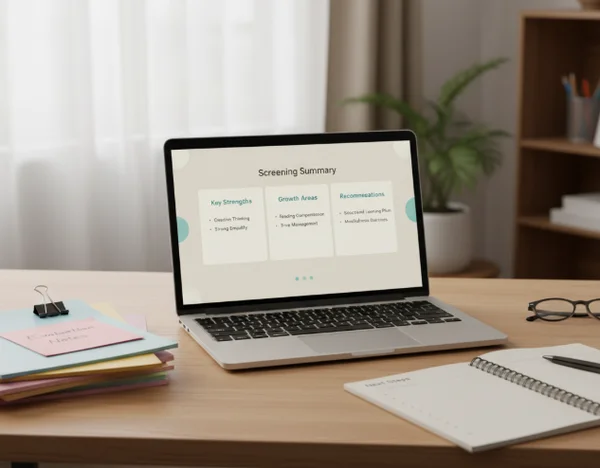
Why screening is only the first step
A screening result is useful because it reduces uncertainty. It can show that reading, spelling, or processing difficulties deserve more attention. It does not diagnose dyslexia on its own.
That boundary matters because a formal evaluation looks beyond one score or one moment. It usually asks how reading challenges have shown up over time, what support has already been tried, and whether similar patterns appear across school, home, or work.
The site's screening result overview is most valuable when it becomes the start of a clearer conversation. The goal is not to arrive with certainty. The goal is to arrive with useful detail.
What formal evaluators usually need to understand
Reading, spelling, and school or work patterns
A formal evaluator usually needs examples, not just concern. That means specific reading patterns, spelling mistakes, writing struggles, and any settings where the difficulty becomes most obvious.
[NICHD's reading-disorder diagnosis guidance] says providers often use a series of tests, including assessments of memory, spelling, visual perception, and reading skills, along with family history and a child's response to instruction. That is a strong reminder that an online screening result is only one part of the picture.
What helps most is concrete observation. Parents can note how long reading homework takes, whether letter-sound matching feels hard, or whether spelling errors stay unusually persistent. Adults can bring examples of reading slowdown, workplace writing challenges, or lifelong patterns that were never fully explained.
Family history and developmental notes
Developmental context can matter too. Some evaluators may ask about early speech, language, school history, or whether similar reading challenges run in the family.
[NICHD's learning-disabilities diagnosis page] notes that special tests are required to diagnose learning disabilities. It also says speech-language pathologists may evaluate learning skills such as understanding directions, manipulating sounds, and reading and writing. That means early language and learning history can help give the evaluator a fuller view.
Families do not need a perfect timeline. A short note about early reading milestones, past interventions, or long-running frustration with reading and spelling is usually enough to make the appointment more productive.
What documents and examples help most
School records, work samples, and teacher feedback
Bring evidence that shows patterns, not just isolated bad days. Reading samples, spelling tests, writing assignments, teacher comments, tutoring reports, and school communication can all help.
The [U.S. Department of Education's dyslexia guidance] says schools may evaluate children to determine whether they are eligible for special education and related services under IDEA. That makes school records especially useful when families are deciding whether a private or school-based evaluation is the better next step.
Adults can do something similar with work examples. Keep short notes about tasks that consistently take much longer than expected, written instructions that are hard to process, or patterns that have followed the person since school years.
Notes from the screening result and daily life
A screening result becomes more useful when it is paired with day-to-day examples. Bring the risk level, the main themes that felt accurate, and a few real situations where the difficulty shows up.
A 7-12 high-risk result, for example, should not be treated as a diagnosis, but it can help families explain why they are seeking more formal help now. Even a 4-6 medium-risk result can be worth documenting if reading and spelling struggles keep appearing across home and school.
The site's post-screening guidance path is a good place to organize those notes before the appointment. A short, clear summary is often more helpful than a long stack of unsorted papers.

When support should not wait for the appointment
Academic distress, self-esteem, and school avoidance
Formal evaluation appointments can take time. Support should not always wait that long. If a child is melting down over reading, refusing school, or showing clear drops in confidence, that is already meaningful information.
The same is true for adults who feel daily shame, avoidance, or growing work stress around reading and writing tasks. Even before a formal diagnosis, the distress itself deserves attention and support.
If symptoms are severe or persistent, seek professional help promptly. A licensed psychologist, reading specialist, school support team, or healthcare provider can help determine what support should start now.
How to ask for help while waiting
While the evaluation is pending, families can still ask questions. Teachers can be told what the screening suggested. Workplaces or schools can be asked what support is possible before the formal report is complete. The point is not to demand certainty. It is to reduce unnecessary strain.
NICHD notes that parent information resources supported by the Office of Special Education Programs can help families learn about laws, policies, and professionals involved in support for children with reading disorders. That matters because families often need guidance before they have a final diagnosis in hand.
Even small supports can help while waiting. Extra reading time, audio support, shorter reading chunks, clearer instructions, or more frequent teacher check-ins can lower distress while the formal process continues.

Next steps: using the screening result to ask better questions
A formal dyslexia evaluation is easier to navigate when the screening result becomes a starting point instead of a final answer. Bring patterns, examples, and a short summary of what has been hardest over time.
That is the real value of an online dyslexia screening tool. It gives families and adults a structured first look. The evaluation is where that first look becomes a deeper conversation about diagnosis, support, and next steps.
If reading-related distress, school refusal, or emotional strain becomes severe or persistent, seek professional help. Early support matters even before the full evaluation is complete.