Dyslexic People and How Reading Differences Really Work
Dyslexic people are often described through what is hard for them: slow reading, spelling mistakes, mixed-up letters, or frustration at school. Those things can be real, but they are not the whole person. Dyslexia is a learning difference that mainly affects word reading, spelling, fluency, and written language. It can also shape confidence, organization, memory, and how someone handles information under pressure. If you are trying to understand a child, a student, or yourself, it helps to begin with early reading clues and next steps rather than a label alone.

What Dyslexic People May Be Like
A person with dyslexia is not one single type of learner. Some dyslexic people love stories but dislike reading aloud. Some speak with imagination but find spelling draining. Some are strong problem solvers who need extra time to decode written instructions. Others hide their reading effort so well that adults only notice the stress, avoidance, or low confidence around schoolwork.
The common thread is not low intelligence or laziness. Dyslexia is usually connected with how the brain processes written and spoken language, especially the sound structure of words, letter-sound links, spelling patterns, and reading fluency. A dyslexic reader may know the answer but need longer to get through the sentence. They may understand a concept well when it is discussed out loud, shown visually, or broken into steps, but struggle when the same idea is locked inside a dense page of text.
This is why dyslexia can feel confusing from the outside. A child may build complex models, tell detailed stories, or solve practical problems, then stumble over a short spelling list. An adult may lead a project confidently but need proofreading support for emails. The uneven profile is part of the pattern.
Signs Dyslexic People May Notice
The signs of dyslexia vary by age, language, teaching history, and support. A young child may have trouble noticing rhymes, remembering letter names, blending sounds, or learning the alphabet in order. In elementary school, signs often become clearer when reading demands increase: slow word reading, guessing from the first letter, skipping small words, spelling the same word several different ways, or avoiding reading aloud.
Teens and adults may show a different picture. They might read accurately but slowly, need to reread instructions, avoid long forms, struggle with note-taking, or spend much longer writing than peers. Some dyslexic people also have trouble remembering sequences, copying from a board, telling left from right quickly, or retrieving the exact word they want when tired.
These signs do not prove dyslexia on their own. Vision, hearing, language exposure, instruction, attention, anxiety, and other learning needs can also affect reading. The useful question is pattern plus persistence: are word reading, spelling, or fluency challenges continuing even with appropriate instruction and practice?
How Dyslexic People Read and See Words
A common myth says dyslexic people simply see words backwards. Some dyslexic learners do reverse letters, especially when young, but reversals are not the core feature of dyslexia and can happen in typical development too. Dyslexia is better understood as a language-processing and word-reading difficulty, not a simple eyesight problem.
So what do words look like to dyslexic people? There is no single visual experience. Many dyslexic readers see the same printed words as everyone else, but the work of matching letters to sounds, recognizing word parts, and reading smoothly takes more effort. Words may not become automatic as quickly. A page can feel crowded because each line demands more attention. Reading speed can drop when the text is unfamiliar, timed, small, poorly spaced, or full of new vocabulary.
Helpful design can reduce strain, even though it does not remove dyslexia. Clear fonts, generous spacing, short paragraphs, left-aligned text, audio support, and uncluttered layouts can make reading more manageable. Some people prefer dyslexia-friendly fonts; others do better with familiar fonts, larger size, or text-to-speech. The best choice is the one that improves access for the individual reader.

Are Dyslexic People Smart?
Yes, many dyslexic people are smart, and dyslexia itself is not a measure of intelligence. A person can have dyslexia and be gifted, average, artistic, analytical, practical, funny, athletic, scientific, entrepreneurial, or any mix of traits. The important point is not that dyslexic people are automatically smarter than others. That claim creates a different kind of pressure. The fairer statement is that dyslexia does not prevent intelligence, creativity, or achievement.
Famous dyslexic people are often used as examples because their stories can be encouraging. Public figures in business, film, sport, art, writing, and science have spoken about dyslexia or reading struggles. Those stories matter most when they show the role of support, self-understanding, persistence, and a better learning fit. They should not be used to suggest that every dyslexic child must become exceptional to be valued.
Dyslexic strengths can include visual thinking, storytelling, pattern recognition, spatial reasoning, practical problem solving, empathy, or big-picture thinking. These strengths are not universal, and they do not erase the need for reading instruction and accommodations. A balanced view gives room for both: dyslexic people may need help with literacy tasks and may also bring valuable ways of thinking.
Dyslexia and ADHD Are Not the Same
Dyslexia is not a form of ADHD. Dyslexia mainly affects reading, spelling, decoding, and written language. ADHD mainly affects attention regulation, impulse control, activity level, and executive functioning. The two can overlap, which is why the question comes up so often, but they are distinct conditions.
The overlap can look messy in daily life. A dyslexic child may lose focus because reading is exhausting. A child with ADHD may miss punctuation, skip lines, or rush through text because attention is hard to sustain. A child with both may have slow decoding and attention challenges at the same time. Adults can experience the same mix at work: written tasks take longer, deadlines feel harder to organize, and reading-heavy systems become frustrating.
Because support differs, careful observation matters. Dyslexic readers often need explicit, structured literacy instruction and tools that reduce the load of print. People with ADHD may need help with planning, timing, reminders, movement, and attention supports. When both are present, both deserve attention.
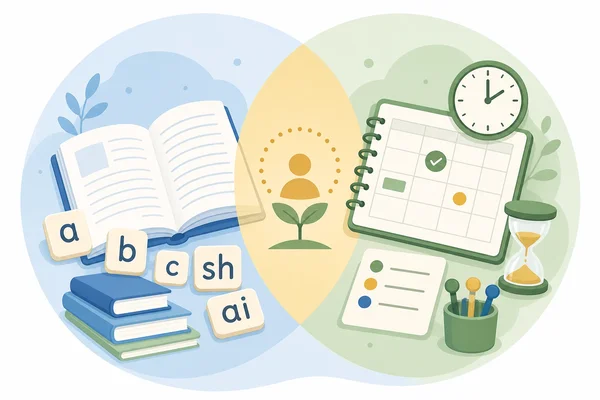
Support That Helps Dyslexic People Thrive
Support works best when it is specific, respectful, and practical. For children, that may include structured literacy instruction, extra reading time, spelling support, audiobooks, text-to-speech, reduced copying, and a calm way to talk about mistakes. For teens, it may include note templates, speech-to-text, planning tools, and permission to show knowledge orally or visually when appropriate. For adults, support may include proofreading systems, meeting notes, assistive technology, and clear written instructions.
Families and teachers can begin with a simple observation checklist:
- Which tasks are easy when spoken but hard when written?
- Does reading accuracy, speed, or spelling remain difficult over time?
- Does the learner avoid reading because it feels tiring or embarrassing?
- What helps most: audio, visuals, more time, step-by-step instructions, or a quieter setting?
- Is there also attention, math, speech, anxiety, or coordination difficulty?
If the pattern seems persistent, a child-friendly dyslexia screening starting point can help families organize observations before speaking with school staff or a qualified professional. A screening result is not a formal assessment, but it can make the next conversation clearer.

Myths About Dyslexic People
Myths can delay support. One myth is that dyslexic people cannot read. Many can read, but it may take more energy, more time, or different tools. Another myth is that dyslexia means seeing every word backwards. In reality, reading fluency, spelling, and sound-symbol processing are usually more central. A third myth is that dyslexic people just need to try harder. Most have been trying hard for years; what changes outcomes is better instruction, better access, and less shame.
There is also a positive-sounding myth: dyslexia is always a gift. Some dyslexic people proudly use that language. Others find it frustrating because it can minimize daily difficulty. A more useful view is that dyslexia is a real learning difference with challenges, strengths, and support needs. People should be allowed to describe their own experience without being forced into either a deficit story or a superhero story.
A Helpful Next Step for Understanding Dyslexic Traits
If you are asking about dyslexic people because of a child, watch for patterns rather than isolated mistakes. Keep examples of reading, spelling, homework time, and emotional reactions. Ask the teacher what they notice across decoding, fluency, comprehension, and writing. If you are asking for yourself, look at your history: slow reading, spelling fatigue, trouble with written instructions, or a long-standing sense that your spoken ideas are stronger than your written output.
The next step does not have to be dramatic. You can explore a free educational dyslexia screening, gather observations, and decide whether a school meeting or formal assessment makes sense. The goal is not to attach a label for its own sake. The goal is to understand the reading profile clearly enough to choose support that protects confidence and opens better ways to learn.
FAQ
What is a person with dyslexia like?
A person with dyslexia may be thoughtful, capable, creative, practical, verbal, quiet, analytical, or any other personality type. Dyslexia does not define character or intelligence. It mainly affects reading, spelling, fluency, and written language, though it can also influence confidence, organization, memory, and how tiring school or work tasks feel.
What are the signs of a dyslexic person?
Common signs include slow or inaccurate word reading, persistent spelling difficulty, trouble sounding out unfamiliar words, avoiding reading aloud, needing to reread instructions, and taking longer to write. In younger children, trouble with rhyming, letter-sound links, and blending sounds can be early clues. Signs should be considered as a pattern over time, not as one mistake.
How does dyslexia affect a person?
Dyslexia can make reading and writing more effortful, especially under time pressure. It may affect school confidence, homework time, note-taking, emails, forms, or workplace documents. With the right instruction, tools, and accommodations, dyslexic people can build strong literacy skills and show knowledge in ways that are not limited by slow print processing.
Is dyslexia a form of ADHD?
No. Dyslexia and ADHD are different, although they can occur together. Dyslexia is mainly about reading, spelling, and language processing. ADHD is mainly about attention, impulsivity, activity level, and executive functioning. A person with both may need reading support and attention-management support.
Can dyslexic people read?
Yes. Dyslexic people can read, but reading may be slower, less automatic, or more tiring. Some read well with structured instruction and practice but still need extra time for dense material. Audio tools, text-to-speech, clear formatting, and explicit literacy instruction can make reading more accessible.
Do dyslexic people read backwards?
Usually, no. Some children reverse letters while learning, and some dyslexic learners may do this too, but dyslexia is not simply reading backwards. The core difficulty is more often with decoding, spelling, word recognition, phonological processing, and reading fluency.
What are dyslexic people good at?
Strengths differ by person. Some dyslexic people are strong in visual thinking, design, storytelling, problem solving, spatial reasoning, practical tasks, or connecting ideas. Others may not identify with those strengths. It is better to notice the individual profile than to assume every dyslexic person has the same talents.