Managing Parent Anxiety After High-Risk Dyslexia Screening: Support & Next Steps
Receiving a "high risk" result from a dyslexia screening can feel like a sudden emotional shock. For many parents, that moment is filled with a wave of anxiety, confusion, and fear for their child’s future. You might find yourself staring at the screen, wondering if you did something wrong or what this means for your child's school years. What are the next steps for a child with reading challenges?
This guide is designed to offer you compassionate support and practical strategies. We want to help you navigate these complex emotions while taking constructive steps. Remember, a high-risk result is not a final label; it is a doorway to understanding and support. By using an online test, you have already taken the most important step: looking for answers to help your child succeed.
Our goal is to move you from a place of worry to a place of empowerment. In the following sections, we will explore why you feel this way, how to manage the stress, and how to turn these results into a positive plan of action.

Understanding Your Emotional Response to High-Risk Results
Seeing a high-risk result often triggers a protective response. It’s biology—your instinct to safeguard your child’s future kicks in. As a parent, your primary instinct is to ensure your child has an easy and successful path in life. When that path seems threatened by a learning difference, anxiety is a common and valid response.
Why High-Risk Screening Results Trigger Parental Anxiety
Anxiety usually stems from the unknown. Before the high-risk screening, you might have had a vague feeling that your child was struggling. However, seeing it in writing makes the challenge feel "real." Many parents worry about social stigma or that their child will fall behind their peers.
There is also a sense of "parental guilt." You might ask yourself why you didn't notice the signs earlier or if you should have read to them more often. It is crucial to understand that dyslexia is a neurobiological condition. It has nothing to do with your parenting or your child's intelligence. High-risk results simply mean their brain processes language differently.
Common Emotional Reactions: From Fear to Determination
Parents often move through a series of emotions after a screening. At first, there is often fear. You might fear that your child won't get into a good college or will be teased at school. This can quickly turn into sadness or a sense of loss for the "typical" academic experience you imagined for them.
However, most parents eventually move toward determination. Once the initial shock wears off, you begin to realize that knowing the truth is better than staying in the dark. This determination is what will drive you to find the right resources. Using a screening tool is the catalyst that turns your quiet worry into active advocacy.
The Difference Between Worry and Productive Concern
It is helpful to distinguish between "unproductive worry" and "productive concern." Unproductive worry involves "what-if" thinking that leads to circles of stress without any solutions. For example, "What if they never learn to read?" is a worry that doesn't help your child today.
Productive concern, on the other hand, leads to action. It sounds like, "My child is at high risk, so I will talk to their teacher about a reading intervention." Productive concern acknowledges the problem but focuses on the solution. By shifting your mindset, you can use your energy to support your child’s unique learning style instead of just feeling stressed.
Practical Coping Strategies for Parents of Children with High-Risk Screening
Managing your own stress is the best way to help your child. Children are very sensitive to their parents' emotions. If you are panicked, they will feel that something is "wrong" with them. If you are calm and focused, they will feel safe. Here are some ways to manage the pressure of a high-risk result.
Immediate Calming Techniques When Anxiety Peaks
If you feel overwhelmed after reviewing the results of a test for dyslexia, take a moment to breathe. Deep breathing exercises can lower your heart rate and clear your mind. Try the "4-7-8" technique: breathe in for 4 seconds, hold for 7, and exhale slowly for 8 seconds.
Another technique is "grounding." Name five things you can see, four things you can touch, and three things you can hear. This pulls your mind out of the future (where the fear lives) and back into the present moment. Remember, your child is the same wonderful person they were five minutes before you took the test. The test result is just new information, not a change in who they are.
Building Your Support Network: Who to Turn to Now
You do not have to carry this weight alone. Building a support network is essential for long-term success. Start by talking to your spouse or a trusted friend. Often, just saying your fears out loud makes them feel smaller and more manageable.
Next, look for professional and community support:
- School Teachers: They see your child’s daily work and can provide context.
- Support Groups: Online forums and local groups for parents of children with dyslexia can provide incredible comfort.
- Educational Consultants: These experts can guide you through the process of getting extra help at school.
Connecting with others who have been through this can help you see that a high-risk result is manageable. Many successful doctors, artists, and CEOs have dyslexia, and their parents once felt exactly like you do now.

Cognitive-Behavioral Strategies for Long-Term Resilience
Cognitive-Behavioral Therapy (CBT) techniques are great for changing the way you think about challenges. One key strategy is "reframing." Instead of thinking, "My child has a disability," try thinking, "My child’s brain is wired for creativity and big-picture thinking, and we just need a different strategy for reading."
Another strategy is to focus on "micro-wins." Instead of worrying about high school graduation when your child is seven, focus on them learning three new phonemes this week. Celebrating small victories builds resilience for both you and your child. This positive reinforcement creates an environment where your child feels brave enough to keep trying, even when reading is hard.
Taking Constructive Next Steps After High-Risk Screening
Once you have managed your initial anxiety, it is time to look at the data. A screening result is a powerful tool that gives you a roadmap. It tells you exactly where the "potholes" in the road might be so you can drive around them or fix them.
Understanding What "High Risk" Really Means
It is vital to remember that an online screening is not a clinical diagnosis. Our screening tool helps you check symptoms and identify potential risks. A "high risk" result means that your child shows many of the common markers associated with dyslexia, such as difficulty with phonological awareness or rapid naming.
It does not mean your child is "broken." It simply means they need a more formal evaluation to confirm the findings and determine the specific type of support they need. Think of a screening like a thermometer: it tells you there is a fever, but you still need a doctor to find out exactly why. This distinction is important because it keeps you from feeling like the situation is "final."
Preparing for Professional Evaluation: Questions to Ask
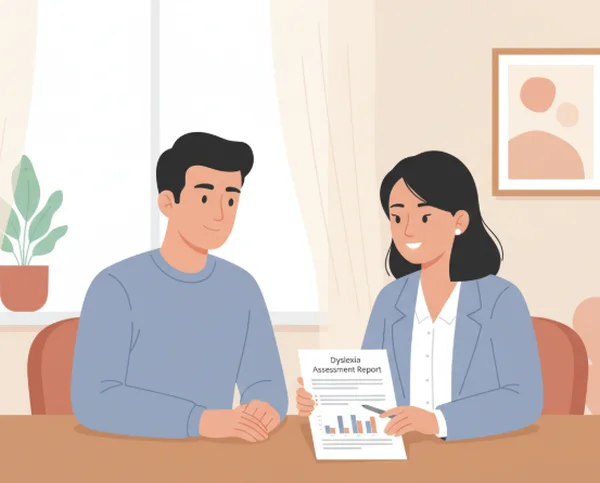
If your screening shows high risk, the next logical step is a professional evaluation by an educational psychologist or a specialized clinic. To make this process less stressful, go prepared. Bring a copy of your screening report and a list of observations about your child’s reading habits at home.
When you meet with a professional, consider asking these questions:
- What specific areas of language processing are most difficult for my child?
- What evidence-based interventions (like Orton-Gillingham) do you recommend?
- How can we translate these findings into an Individualized Education Program (IEP) at school?
- What are my child’s cognitive strengths that we can lean on?
A plan turns you from a bystander into a leader. Bring questions to meetings—it shows you’re ready to champion your child’s needs.
How to Communicate with Your Child About Screening Results
This is often the part parents dread the most. However, children often sense their struggles. Watching peers read faster can leave them feeling left behind—but naming the challenge helps them cope. Giving it a name can actually be a relief for them.
Explain it simply: "You know how some people are really fast runners and others are great at drawing? Well, your brain is amazing at [insert strength], but it has to work extra hard to turn letters into sounds. We found a way to help your brain learn that easier." Avoid using "scary" medical words. Focus on the fact that they are smart and that you are going to get them the right "tools" to make school more fun.
Your Journey Forward: From Anxiety to Empowerment
Feeling anxious? You’re not alone. Many parents share these worries, but you’ve already taken the bravest step: seeking answers. A high-risk dyslexia screening result is not a crisis—it is a turning point. It is the moment you stop guessing and start supporting. By identifying these risks early, you are giving your child the best possible chance to reach their full potential.
Take a deep breath and remember these three things:
- You are an advocate for your child, and your intervention matters.
- Dyslexia is a different way of thinking, often linked to high creativity and problem-solving.
- Action is the best cure for anxiety.
If you haven't yet received a detailed breakdown of your child's reading profile, or if you want to verify your concerns, we encourage you to start your test today. Knowledge is the foundation of confidence. Once you understand the risks, you can begin the beautiful work of unlocking your child's reading potential.
The Takeaway
What should I do immediately after receiving high-risk dyslexia screening results?
The first thing to do is stay calm and realize that a screening is not a diagnosis. Your next step should be to download or print your results and schedule a meeting with your child's teacher or school counselor. Share the findings from the online test and ask about the school's process for further evaluation and reading support.
How do I explain high-risk screening results to my child?
Focus on their strengths. Tell them that everyone’s brain works differently and that the test showed they might need some "special tricks" to help with reading. Emphasize that being "at risk" for dyslexia has nothing to do with how smart they are. The goal is to make them feel supported, not labeled.
Is a high-risk screening result the same as a dyslexia diagnosis?
No, it is not. A screening identifies "red flags" and patterns that suggest a high probability of dyslexia. A formal diagnosis requires a comprehensive assessment by a qualified professional, such as a neuropsychologist. However, a screening is a vital first step to see if a full professional support evaluation is necessary.
What are the most effective coping strategies for parental anxiety?
Start small: Chat with parents who’ve been there, or explore one new resource today. Progress over perfection! Educate yourself about dyslexia and practice mindfulness to stay in the present. Shifting from "why is this happening?" to "how can I help?" is the most effective way to reduce stress.
When should I seek professional evaluation after high-risk screening?
You should seek a professional evaluation as soon as possible after a high-risk result, especially if the child is already showing frustration in school. Early intervention is key to preventing the loss of self-esteem that often comes with reading struggles. You can begin by using a screening tool to gather initial data for the specialist.